
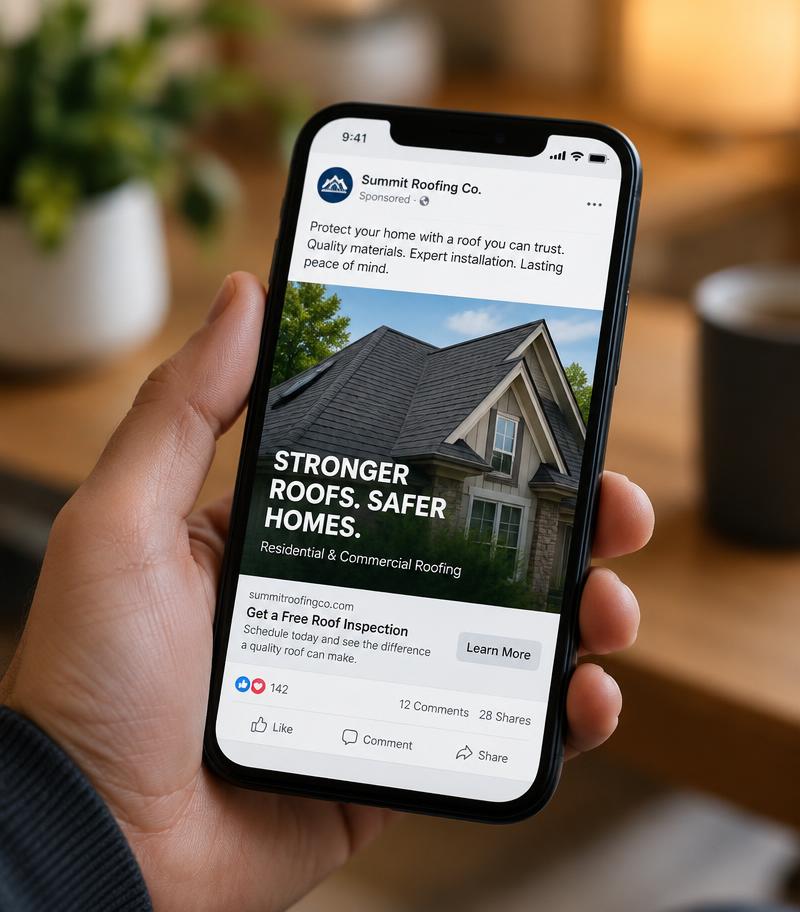
How Contractor Traffic uses Meta advertising
Meta ads run on an auction. Each time someone opens Facebook or Instagram, the platform decides which ad to show based on your bid, how relevant the ad is, and the experience it expects for that person. Our job is to give that system a clear objective, a sensible audience, and creative that actually looks like your work.
We start with what you want: which services, which areas, and how many jobs your crews can realistically take on. From there we build campaigns around one goal at a time — usually qualified estimate requests — instead of running everything at once and hoping something sticks.
Facebook Ads for Contractors
Facebook is where a lot of local conversation still happens — neighborhood groups, community pages, and the feeds of homeowners who own their homes and make the repair and replacement decisions. It suits offers that need a little explaining: financing, seasonal programs, inspection visits, and before-and-after project work.
We run Facebook campaigns with straightforward copy, a clear service area, and an obvious next step, so people who aren’t ready to buy today still know who to call later.
Instagram Ads for Contractors
Instagram is where finished work looks best. Placements in feed, Stories, and Reels let you show a completed roof, a new patio, or a tidy job site in a way a text ad simply can’t.
We build Instagram creative from short vertical clips and photos of your own jobs. A crew working on a real house almost always outperforms polished stock footage, because it looks like the company the homeowner would actually be letting onto their property.
Local Lead Generation
Meta can reach a very wide audience, which is usually the last thing a contractor needs. We aim campaigns at the cities and neighborhoods your crews genuinely serve, keep budget on the areas producing booked work, and treat out-of-area inquiries as a targeting problem to fix rather than noise to live with.
For lead generation we favor campaigns measured on contacted and qualified leads, not on how many people submitted a form.
Audience Targeting
Targeting works best when it stays simple. We define an audience by location, an appropriate age range, and broad interests tied to homeownership and home improvement, then let Meta’s delivery find people inside it. Stacking too many narrow interests usually just makes campaigns more expensive.
Where you have a customer list or a history of past leads, we use it. Uploading those contacts lets the platform learn who actually hires you and find similar people, which is generally more useful than guessing at interests.
Creative Strategy
In a feed full of ads, the creative does most of the work. We build around your own project photos and clips, and test several hooks and formats at once rather than putting one polished video in front of everyone.
- A clear first second, so people know within a moment what you do and where
- Captions on every video, because much of the feed is watched with the sound off
- Before-and-after and job-site photos from your own projects
- Plain, specific offers instead of vague slogans
- Regular rotation and testing, so ads are replaced before they go stale
Lead Forms
Instant forms keep people inside Facebook or Instagram and prefill their name and contact details, which lowers the effort of raising a hand. We add qualifying questions — property type, the work needed, when they want it done — so your team spends less time on conversations that were never going to become jobs.
Lead forms can be delivered to your email, a spreadsheet, or your CRM, so inquiries arrive somewhere they won’t sit unread.
Landing Pages
For larger projects, sending people to your own website is often the better move — homeowners want to read and compare before they call. Those pages should repeat the offer from the ad, load quickly on a phone, show your service area and credentials, and make calling or requesting an estimate obvious.
A campaign and a landing page that disagree with each other is one of the most common reasons good traffic never becomes a lead. We coordinate the two so the message someone clicked on is the message they land on.
Retargeting
People rarely hire a contractor the first time they see an ad. Retargeting keeps your company in front of those who already showed interest — visited your website, watched a video, opened a form, or engaged with your page — with a follow-up such as project photos, an explanation of financing, or a simple reminder to request an estimate.
It’s usually the most efficient part of a Meta budget: the audience is small, warm, and already knows your name.
Campaign Tracking
Meta’s own dashboard only tells part of the story. We set up the Meta Pixel and Conversions API so website activity is reported accurately, agree on which actions count as a lead, and line campaign data up with calls and form submissions so decisions are based on leads rather than impressions.
When your team marks which inquiries turned into jobs, we tie that back to the campaigns and creative that produced them — the step most contractors skip, and the one that makes budget decisions obvious.
Lead Follow-Up
Social leads are typically earlier in the buying process than search leads, which makes speed the deciding factor. A homeowner who filled out a form while scrolling is far more likely to answer a call or text in the first few minutes than an hour later.
We help you set up a simple response routine — where leads land, who answers, what the first message says — and route inquiries so nothing sits waiting in a platform inbox.
Residential Contractor Advertising
Homeowners are the natural fit for Meta advertising. They consider projects over weeks or months, they respond to visual proof, and they often ask neighbors for recommendations before they ever search. We build residential campaigns around the projects homeowners plan in advance — roof replacements, HVAC upgrades, remodels, outdoor living work — and keep the message centered on trust: local, insured, licensed where required, and easy to reach.
Offers that may suit Meta advertising
Some contractor offers fit social advertising well and others don’t. Rather than promise outcomes, here is how we judge the fit before recommending a budget.
- Projects people plan ahead of time — roof replacements, window and door installs, patios, decks, and remodels
- Seasonal programs such as pre-summer AC tune-ups or pre-winter inspections, where the demand window is predictable
- Financing offers that make a larger project feel reachable to a homeowner who was already considering it
- Neighborhood-focused work, where visible local projects and before-and-after photos build familiarity
- Storm or post-event service, where you want to reach one specific area quickly
- Recurring service programs — maintenance plans, filter and inspection visits — offered to past customers
When search or email is the better tool
Meta is usually the wrong place for emergencies. A burst pipe or a furnace that died at midnight is a search-and-call moment, not a scrolling moment; those inquiries belong with Google Ads and call-focused campaigns.
If your work is mainly awarded through bids and relationships with general contractors, targeted email outreach to facility and property managers tends to do more for you than a feed ad. We will tell you when a channel isn’t the right fit instead of selling you a budget to fill.
Meta Ads for Roofing Companies
Roofing work photographs well and homeowners research replacements long before the first leak. We use project photos and inspection offers to stay visible through the planning window, and keep storm-season pushes tightly scoped to the areas your crews can reach.
Meta Ads for HVAC Companies
HVAC has a natural rhythm: maintenance interest in the shoulder seasons, urgent replacement conversations during heat waves and cold snaps. Meta campaigns work for the planned side of that — tune-up programs, replacement financing, and maintenance plans — while emergencies stay with search.
Meta Ads for General Contractors
Remodels and additions are visual, considered purchases, which suits social advertising well. We showcase completed builds and the process behind them, and use retargeting to stay present through the long stretch between first interest and signed contract.
Meta Ads for Plumbers and Electricians
Most plumbing and electrical work is urgent and belongs in search. The exceptions are the planned jobs: repipes, panel upgrades, EV charger installs, and remodel rough-ins. Those are the campaigns we run on Meta, aimed at homeowners already thinking about the work.
Meta Ads for Concrete, Drywall, Painting, and Carpentry
Stamped driveways, painted feature walls, custom cabinetry, and finished decks are the kind of work people save and share. We use those visuals to reach homeowners planning outdoor and interior projects, and to keep your name in mind when they finally get to the top of the list.
Meta Ads Management in Southern California
Contractor Traffic works with trade businesses across Southern California, and the right Meta setup depends on where you are. A Los Angeles contractor is competing for attention across a dense, expensive metro, which makes tight neighborhood targeting and strong creative essential. In Jurupa Valley and the Inland Empire, campaigns can lean on visible local projects and growing neighborhoods.
Here is how we support contractors in each of those areas.
What to expect
Meta advertising results depend on your market, your offer, your creative, your budget, and how quickly your team follows up. We don’t promise a specific number of leads, a cost per lead, or a return.
What we commit to is a clear plan, accurate tracking, steady creative work, and reporting on spend, leads, and what happened to those leads — so you can judge the channel on the same evidence your team sees.